Data and MLOpen source
orya-guard
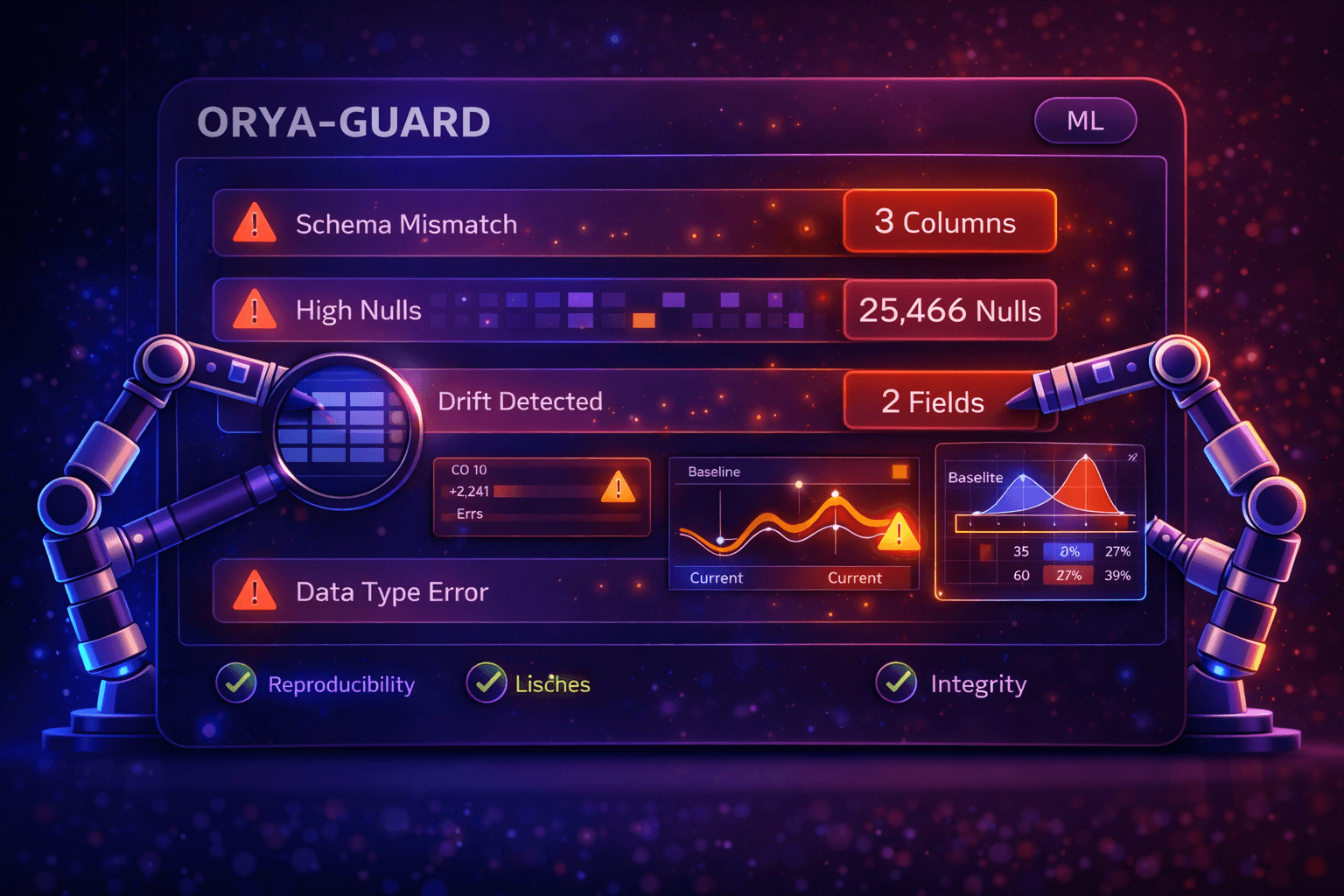
A practical Python CLI for preflight validation of ML datasets and inference payloads, designed to catch schema mismatches, null spikes, drift signals, and type-level issues before they break downstream work.
The brief
Many ML problems start before the model: a dataset arrives with a changed schema, a column suddenly fills with nulls, or a serving payload carries the wrong field type. ML engineers often find these issues only after training results or production behaviour already look wrong.
orya-guard had to be a lightweight Python CLI that runs preflight validation on tabular datasets before training and checks inference payloads before serving, flagging schema mismatches, null spikes, drift signals, and field-type issues in clear, ML-focused terms.
How we approached it
- 1
Preflight and serving-time checks
One CLI covers both checkpoints: preflight validation of training datasets and serving-time validation of inference payloads, so inputs are checked before training and again before serving.
- 2
Checks that speak ML
Checks target what matters to models, such as schema mismatches, null spikes, drift signals, and field-type problems, rather than generic data linting.
- 3
Lightweight by design
A small command-line footprint keeps the tool easy to add to an existing ML workflow without introducing another platform to run and maintain.
What we delivered
- Preflight checks for tabular datasets before training
- Validation of inference payloads before serving
- Clear ML-focused checks for schema mismatches, null spikes, drift signals, and field-type issues
- Developed directly by the founder of Orya One
What it had to achieve
- Reduce hidden quality issues before model training starts
- Catch serving-time input problems earlier
- Make ML delivery feel safer and more controlled operationally