Website & Software Development in Katerini and Pieria: A Practical Guide for Local Businesses
A practical guide for businesses in Katerini and along the Pieria coast: what to put online, how to rank in local search, and when a website should grow into software.
Orya One
Guide9 min read
Key takeaways
- Most local customers want five answers fast: open, where, call, price, book.
- Greek plus English is the baseline on the coast; add a third language only where your guests justify it.
- Your Google Business Profile and website must say exactly the same thing, especially seasonal hours.
- Build custom software only when spreadsheets and off-the-shelf tools are clearly holding the season back.
If you run a business in Katerini or along the Pieria coast, your website has two jobs that most templates ignore. It has to win local searches from people who are already nearby, and it has to convert visitors who arrive in July from Belgrade, Sofia, Bucharest or Munich and read neither Greek nor your menu board. For most local businesses that means a fast, mobile-first, bilingual site connected to a well-kept Google Business Profile, with click-to-call, a map link and reviews in plain view. That foundation matters far more than design trends or a long list of pages.
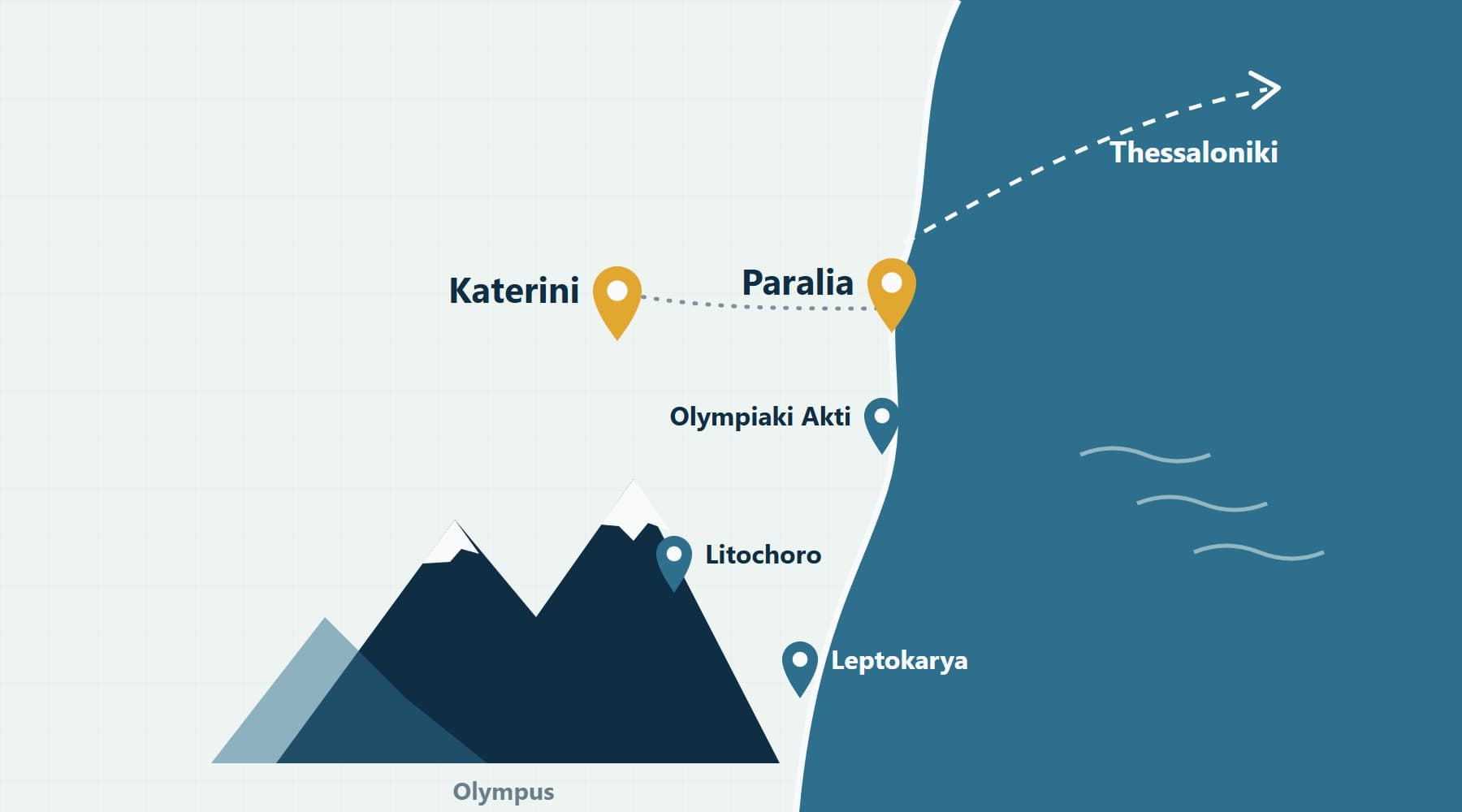
This guide is written for owners in Katerini, Paralia Katerinis, Olympiaki Akti, Leptokarya, Litochoro and Platamonas. It covers what the local economy actually demands from a website, a local SEO checklist you can work through yourself, which setup suits which type of business, when it is worth going beyond a website into booking systems, internal tools or dashboards, and how to choose between a local partner, a remote agency and a DIY builder.
It is opinionated on purpose. A seasonal business has a short window to earn its year, so the advice below favours what pays back quickly over what looks impressive in a portfolio.
How the Pieria economy shapes what you need online
Pieria is compact but unusually mixed. Katerini, the regional capital, is a year-round market town of shops, professional services, workshops and trades. A few kilometres east, Paralia Katerinis and Olympiaki Akti fill up every summer. Further south, Leptokarya, Litochoro (the usual base for Mount Olympus) and Platamonas, with its hilltop castle, make up much of what is marketed as the Olympus Riviera. Thessaloniki is roughly an hour north by motorway, which means many customers compare you with city businesses before they ever arrive.
- Tourism and hospitality: hotels, rooms to let, beach bars and tavernas. Demand compresses into roughly June to September, with shoulder months that depend heavily on weather and Easter dates.
- Retail and services in Katerini: year-round, mostly local customers, many of whom search “near me” on their phones before they leave the house.
- Trades: plumbers, electricians, air-conditioning installers and mechanics, with demand spikes before the season (renovations) and during heatwaves (AC breakdowns).
- Agriculture and food producers: Pieria is one of Greece's main kiwi-growing areas, alongside olive oil, honey, wine and fishing. Buyers range from wholesalers and exporters to direct customers.
The common thread is seasonality. A beach taverna may earn most of its annual revenue in about a hundred days. A site that is slow, Greek-only or out of date on 1 June costs money that cannot be recovered in October. Plan the work in winter and launch by Easter.
What local customers actually need from your website
Forget the brochure. Most visits to a local business website are short and practical: are you open, where are you, how do I call, roughly what does it cost, can I book. Design for those five questions before anything else.
Mobile-first and fast
In a resort town most visits come from phones, often on crowded beach mobile data. Aim for pages that load in a couple of seconds on 4G: compressed images, no autoplaying video header, as few third-party scripts as possible. Test on your own phone outside, not on office Wi-Fi.
Click-to-call, maps and opening hours
Put a tap-to-call number at the top of every page, a link that opens Google Maps directions (an embedded map alone is awkward on a phone), and opening hours that match your Google Business Profile exactly. Many foreign visitors prefer messaging to calling, so a WhatsApp or Viber link is worth adding if someone will actually answer it.
Bilingual Greek and English, sometimes more
Foreign visitors to the Pieria coast come largely from neighbouring Balkan countries such as Serbia, North Macedonia, Bulgaria and Romania, with Germany and other Central European markets also present. Greek plus English is the baseline. For hospitality, add a third language only if your own booking data shows a clear group. Do it properly: separate URLs per language, hreflang tags, and text checked by a person. A machine-translation widget that rewrites the page in the browser does little for search, because Google indexes the original.
Real photos and visible reviews
Stock photos of a generic beach do not sell a specific room or dish. Use recent, real photos taken in good light, and show a few genuine reviews with a link to your Google profile. Visitors check reviews anyway; meeting them halfway builds trust.
A local SEO checklist for Katerini and Pieria businesses
Google says local results are based mainly on relevance, distance and prominence (Google Business Profile Help). You cannot change your distance from the searcher, but you can control the other two. Work through this list once properly and then revisit it every spring.
- Claim and verify your Google Business Profile and choose the most specific primary category available.
- Use exactly the same business name, address and phone number everywhere: website footer, Google, Facebook, Instagram and Greek directories such as vrisko.gr and xo.gr.
- Write the address the way people search it, in both scripts where it helps: Paralia Katerinis and Παραλία Κατερίνης.
- Give each main service or location its own page with genuinely different content. Avoid near-identical “doorway” pages for every village.
- Use place names naturally in titles and headings, such as “emergency plumber in Katerini” or “family rooms in Olympiaki Akti”.
- Add LocalBusiness structured data with address, coordinates, phone and opening hours.
- Ask every satisfied customer for a review, and reply to all reviews, in the reviewer's language where you can.
- Before the season, post opening dates, new photos and menu changes to your profile.
- Set seasonal and holiday hours. A profile showing “open” in February when you are closed is the most common local SEO failure on the coast.
- Connect Google Search Console and check which searches actually bring people to the site.
Recommended setups by business type
Not every business needs the same thing. This is the starting point we would suggest for common business types in the area, before any extras.
| Business type | Main customer | Recommended setup | Worth adding later |
|---|---|---|---|
| Hotel or rooms to let | Greek and foreign guests booking ahead | Bilingual room-led site with integrated booking engine | Google free booking links, guest email list, third language |
| Beach taverna or restaurant | Tourists on the day, locals at weekends | Fast small site, menu as text in two languages, map, call button | Table reservations, seasonal specials page |
| Café or beach bar | Walk-ins | Strong Google profile plus a simple one-page site | Events page, Instagram link |
| Trades in Katerini | Locals with an urgent problem | Service pages by job type and area, click-to-call, quote form | Job scheduling or quoting tool |
| Shop or fish market | Locals and visitors | Storefront site with products, hours, phone or WhatsApp ordering | Online ordering if delivery logistics work |
| Clinic or professional office | Local residents | Trust-led site: services, people, clear appointment request | Online booking, secure forms |
| Food producer | Wholesalers, exporters, direct buyers | Bilingual catalogue site with certifications and B2B enquiry form | Order and stock dashboard |
Local partner, remote agency or DIY builder?
All three can work. The right choice depends on how much the site earns you and how much of your own time you can give it.
DIY website builders
Builders such as Wix or Squarespace are fine for a café that needs three pages and an owner who enjoys editing them. The hidden costs are your time in high season, multilingual setups that are often clumsy, and nobody to call when something breaks on a Saturday in August.
Remote agencies
Larger agencies in Athens or abroad usually have solid processes. The trade-off is distance: you may deal with an account manager rather than the developer, and nobody understands why your opening hours change three times a year or why your guests are mostly from Skopje rather than London.
A local partner
A local team can meet you, photograph the place in person and knows the seasonal rhythm. The risk is capacity, so ask how they handle support in peak season. Our decision rule: if the site drives bookings or leads worth more than a few thousand euros a season, pay for a professional build and a named person who is accountable for keeping it running. For indicative budgets, see our guide to business website costs in Greece.
Beyond the website: software for seasonal businesses
Many Pieria businesses outgrow spreadsheets in the same way. The owner holds the real numbers in their head, seasonal staff change every year, and nobody can see margins until the accountant closes the books in spring. Typical next steps look like this:
- Booking and availability tools for owners managing several apartments or rooms outside a full hotel system.
- Internal tools for staff rotas, prep lists, supplier orders and handovers between shifts.
- KPI dashboards showing daily revenue, covers, occupancy and cost per unit, explained in our guide to a small business KPI dashboard.
- Forecasting for stock and staffing across the season, using your own past data.
- Integrations connecting a POS, booking engine, e-shop and accounting so the same number is not typed in three places.
Off-the-shelf tools should come first; build custom only when you hit a clear limit. Our Cost-to-Profit Operating System reference is an example of the dashboard type: one view of costs and margins instead of a stack of spreadsheets. Before commissioning anything custom, list the three questions your current tools cannot answer; if you cannot name three, you probably do not need it yet.
How to choose a provider: questions to ask
- Can I see live sites you built for businesses like mine, and could I speak to one of those owners?
- Who will I actually talk to during the project and after launch?
- Will the domain, hosting account and content be registered in my name?
- How do you handle the second language: separate URLs, hreflang, human-checked text?
- How fast is the site on a mid-range phone? Show me a PageSpeed result for a recent build.
- What does maintenance include after launch: updates, backups, uptime monitoring, small edits?
- Is the site built to accessibility standards? This increasingly matters under the European Accessibility Act, especially for sites that sell or take bookings online.
- If the site breaks in July, how quickly will someone respond?
How Orya One can help
Orya One is based in Paralia Katerinis and works with businesses across Pieria and beyond. Our live work includes the bilingual, room-led Achillion Hotel site, Megkas Restaurant and the Fish Market Gregory storefront, alongside software such as dashboards and internal tools. You can see them in our selected work. You speak directly with the people doing the work, from the first call to the support request in August.
If you are planning a new site, or wondering whether your spreadsheets have become a liability, get in touch with a short description of the business and what you want it to do. We will tell you honestly whether you need a website, software, both, or just a better Google profile.
Frequently asked questions
How much does a website cost for a small business in Katerini?
It depends on scope. A simple bilingual site for a shop, café or trade usually costs far less than a multilingual hotel site with a booking engine or a storefront with online orders. Expect the price to grow with the number of languages, custom features and integrations. Always ask for a written scope, and check what yearly hosting and maintenance will cost after launch.
Do I need my business website in English as well as Greek?
If you serve tourists, yes. Visitors to the Pieria coast come largely from Balkan and Central European countries, and English is the shared language for most of them. Use separate language versions with proper hreflang tags rather than an automatic translation widget. Add a third language, such as Serbian, Bulgarian, Romanian or German, only if your own customer data shows a clear group.
Is a Google Business Profile enough without a website?
For a small café or kiosk it can be a reasonable start, but it is rarely enough on its own. A profile gives you limited space, no control over layout, and no proper place for menus, rooms, service details or a second language. A small, fast website linked from your profile gives Google more to understand and gives customers somewhere trustworthy to check before they call or book.
How long does it take to build a business website?
A small bilingual business site typically takes a few weeks from agreed content to launch, and the content, especially photos and translations, is usually the slowest part. Sites with booking engines, online ordering or custom integrations take longer. For seasonal businesses on the Pieria coast, start in late autumn or winter so the site is live, tested and indexed by Google well before Easter.
When should a seasonal business in Pieria start working on its website?
Start in the off-season, ideally between November and February. That leaves time to gather real photos, write and translate content, build and test the site, and let search engines index it before spring searches begin. Launching in June means you lose the period when many guests compare options and book. Use summer only for small updates, not for rebuilding the site.