How Much Does a Business Website Cost in Greece in 2026?
What a business website really costs in Greece in 2026, tier by tier, including the domain, hosting and maintenance costs that cheap quotes leave out.
Orya One
Guide8 min read
Key takeaways
- Indicative 2026 ranges: €400–€1,500 for a one-page site, €1,500–€5,000 for a multi-page site, €3,000–€15,000+ for booking sites and e-shops, excluding 24% VAT.
- Recurring costs (domain, hosting, email, maintenance) typically add €150–€2,000 a year.
- Bilingual Greek/English sites usually cost 20–40% more, and need separate URLs per language to rank.
- Always register the domain and hosting in your own name; most cheap-website problems start there.
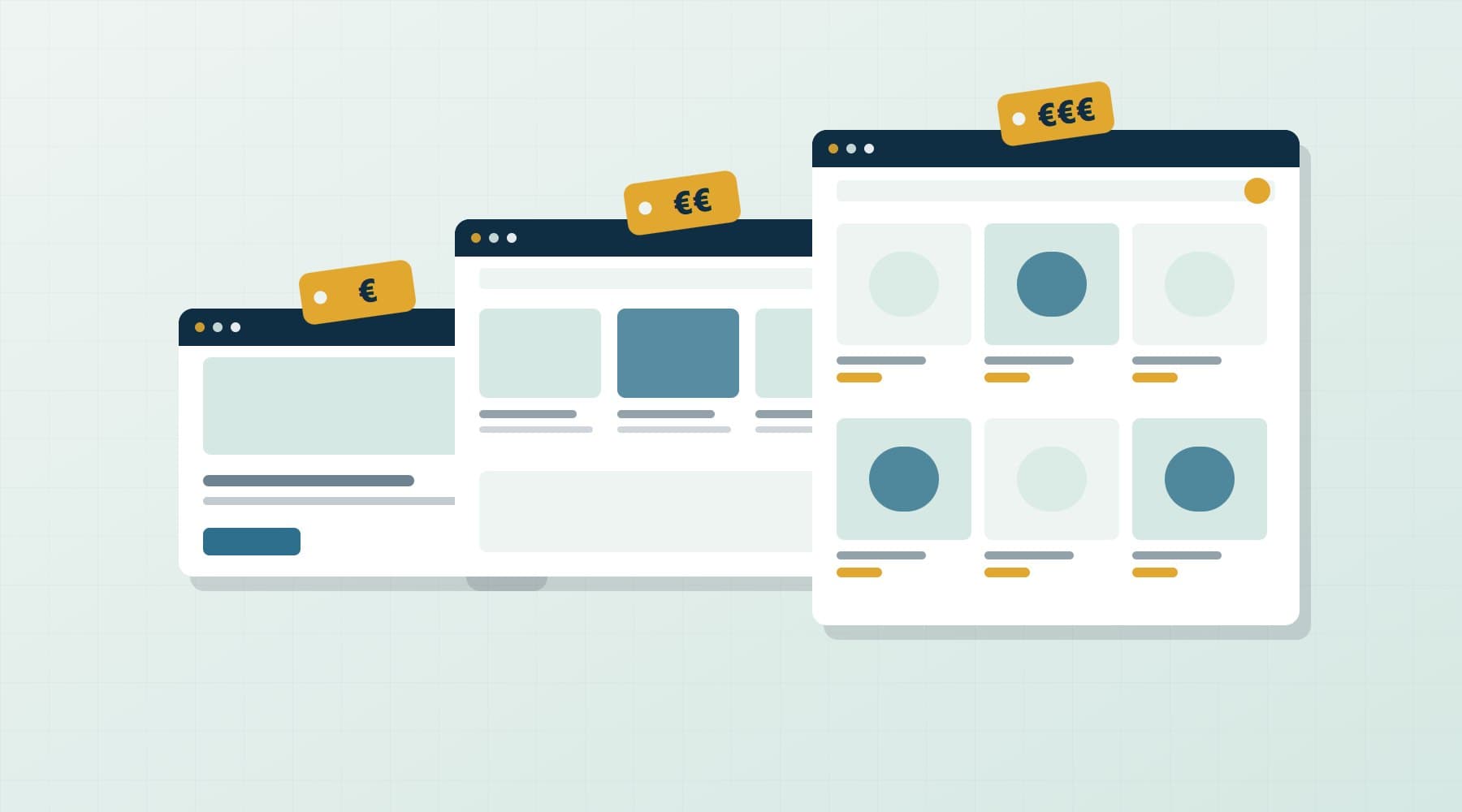
A business website in Greece in 2026 typically costs €400–€1,500 for a simple one-page site, €1,500–€5,000 for a multi-page business site, and €3,000–€15,000 or more for a booking site or e-shop. Custom web applications start at around €10,000. These are indicative market ranges for Greece and Southern Europe, excluding 24% VAT, and they vary with scope, content and who does the work.
On top of the build, expect recurring costs of roughly €150–€2,000 a year for the domain, hosting, email and maintenance. The cheapest quote is rarely the cheapest website: the difference usually shows up later as a slow site, missing backups, or a domain registered in the agency’s name instead of yours.
Below: what each tier includes, the running costs, platform trade-offs, bilingual and accessibility considerations, and the questions to ask before you hire anyone.
Website cost tiers at a glance
| Tier | What you get | Indicative build cost | Typical timeline |
|---|---|---|---|
| One-page / brochure | Single scrolling page: services, photos, map, opening hours, contact, click-to-call | €400–€1,500 | 1–2 weeks |
| Multi-page business site | 5–15 pages, a page per service, basic SEO, forms, analytics | €1,500–€5,000 | 3–6 weeks |
| Bilingual site (Greek/English) | As above in two languages, language switcher, hreflang, translated metadata | €2,500–€7,000 | 4–8 weeks |
| Booking or reservation site | Rooms, tables or appointments, booking engine integration, confirmations | €3,000–€10,000 | 4–10 weeks |
| E-shop | Catalogue, cart, payments, shipping rules, invoicing, stock | €3,000–€15,000+ | 6–12 weeks |
| Custom web application | Logins, dashboards, business logic, integrations | €10,000+ | 2–6 months |
What is included at each tier
One-page or brochure site
Right for a barber, a plumber or a beach bar with a short season. It should include a mobile-first layout, click-to-call, a map, opening hours, a contact form, a link to your Google Business Profile, and proper page titles and descriptions. It should not be a template with your logo dropped in and placeholder text left in the footer.
Multi-page business site
The standard for most service businesses. One page per service usually ranks better than a list on a single page, because each page can answer a specific search, such as “emergency electrician Katerini” rather than just “electrician”. Expect structured data, analytics, cookie consent, a privacy policy, and a simple way for you to edit text and photos yourself.
Booking, reservation and e-shop sites
Here the engine matters more than the design. Hotels normally connect an existing booking engine and channel manager rather than building availability from scratch, which is why the build price excludes the engine’s subscription or commission. E-shops need a payment gateway, shipping rules, courier integration and invoicing that fits Greek tax requirements, which in practice means connecting to your myDATA-compatible invoicing software. Our guide to hotel direct bookings covers the booking side in detail.
Custom web application
Once the site does real work, such as client portals, quote calculators, member areas or staff tools, it is software and should be scoped and priced like software, with roles, data and integrations defined in writing.
Content and photography: the hidden variable
Two quotes for the same tier often differ because one assumes you supply all the text and photos, and the other includes copywriting and a photo shoot. Professional photography of rooms, dishes or a workshop is frequently the single best investment in a small-business site, and stock photos of smiling strangers are the fastest way to look like everyone else. Decide early who writes each page, who translates it, and who takes the pictures, then make sure the quote says so. Late content is also one of the usual reasons website projects run weeks behind schedule, so have the material ready before design starts.
Recurring costs you should budget for
| Item | Indicative annual cost | Notes |
|---|---|---|
| .gr domain | €10–€40 | Varies widely by registrar; often sold in two-year terms. Register it in your own name. |
| Hosting | €60–€600 | Shared hosting at the low end; managed or cloud hosting for busier sites |
| SSL certificate | €0–€100 | Free certificates are fine for most business sites |
| Business email | €50–€300 | Depends on the number of mailboxes and the provider |
| Maintenance and updates | €300–€1,800 | Updates, backups, monitoring, small content changes |
| Booking engine or e-shop fees | Varies | Monthly subscription, commission per booking or sale, or both |
Maintenance is the line people cut first and regret most. A WordPress site with a dozen plugins needs regular updates; skipped updates are a common way small-business sites get compromised. A static or custom-built site needs less, but it still needs backups, uptime monitoring and someone who answers the phone when something breaks in July.
Website builders vs WordPress vs custom (Next.js)
| Option | Upfront cost | Running cost | Strengths | Weaknesses |
|---|---|---|---|---|
| Website builder (Wix, Squarespace, Shopify) | Low | Monthly subscription that rises with features | Fast to launch, easy to edit yourself | Limited performance tuning, platform lock-in, harder to migrate |
| WordPress | Low to medium | Hosting, plugin licences, regular updates | Huge ecosystem, familiar editor, good for content-heavy sites | Plugin bloat, security upkeep, speed depends heavily on build quality |
| Custom (e.g. Next.js) | Medium to high | Low hosting, lighter maintenance | Very fast, secure, flexible, nothing unnecessary | Content editing needs a CMS or a developer; fewer cheap freelancers |
- Choose a builder if you need something live this month, will edit it yourself, and accept the platform’s limits.
- Choose WordPress if you publish content weekly, need a familiar editor, and will pay for proper maintenance.
- Choose custom if speed, search visibility and low upkeep matter more than editing every page yourself, or if the site must connect to other systems.
Bilingual Greek/English sites for tourism businesses
For hotels, restaurants, rentals and tour operators, an English version isn’t a nice extra; it is where many of your future guests start. Done properly, bilingual adds about 20–40% to the build cost. Done badly, it adds nothing, because Google never indexes the second language.
- Give each language its own URL (for example /en/), not a toggle that swaps text on the same address. Mark the versions with hreflang, as described in Google’s guidance on localised versions.
- Use human translation, or at least careful human editing of machine translation. Menus and room descriptions are exactly what guests read closely.
- Translate page titles, meta descriptions, image alt text, forms, confirmation emails and error messages, not only the visible page text.
- Use Latin-character URL slugs for the Greek version too; they are easier to share and less likely to break in messaging apps.
- Check your booking data before paying for a third or fourth language. Add the languages your guests actually use.
The Achillion Hotel website in Paralia is one example of a bilingual hotel site we have built; you can find it on our selected work page alongside restaurant sites such as Megkas Restaurant and Fish Market Gregory.
SEO, performance and accessibility are cost items, not extras
These three are where quotes are most often vague. Ask each supplier to state exactly what is included.
SEO foundations
Every site should launch with unique page titles and descriptions, a logical heading structure, structured data for your business type, an XML sitemap, redirects from any old URLs, and a connected Google Business Profile. That is build work. Ongoing SEO, such as content and link building, is a separate monthly service and should be priced separately.
Performance
Google’s Core Web Vitals set clear targets: Largest Contentful Paint within 2.5 seconds, Interaction to Next Paint under 200 milliseconds, and Cumulative Layout Shift under 0.1. Ask to see mobile scores before launch, not after. Oversized photos and heavy page builders are the usual culprits.
Accessibility and the European Accessibility Act
The European Accessibility Act (Directive (EU) 2019/882) has applied since 28 June 2025 and was transposed in Greece by Law 4994/2022. It covers certain products and consumer services, including e-commerce. Microenterprises providing services, meaning fewer than 10 employees and an annual turnover or balance sheet total of no more than €2 million, are exempt from the service requirements. Whether your site is in scope depends on what you sell online and your size, so read our European Accessibility Act guide and check with your adviser.
Even if you are exempt, accessible design (readable contrast, keyboard navigation, labelled forms, alt text) helps every visitor and costs little when built in from the start. Retrofitting an existing site is usually the expensive route.
Cheap-website traps to avoid
- The domain is registered in the agency’s name, so leaving means losing your address.
- You have no login to the hosting account or the site’s admin panel.
- A heavy template with twenty or more plugins that loads slowly on mobile.
- No backups, or backups stored on the same server as the site.
- Machine-translated English that nobody has read.
- A “free” website tied to a long hosting contract at an inflated price.
- No privacy policy, cookie consent or contact form spam protection.
- An annual fee that includes “SEO” with no defined deliverables.
Questions to ask before hiring a web developer
- Will the domain, hosting and analytics accounts be in my name?
- Which platform will you use, and why is it right for my business?
- What exactly is included: number of pages, languages, forms, integrations?
- Who writes and translates the content, and who supplies the photos?
- What mobile performance scores will the site achieve at launch?
- Which SEO foundations are included, and what costs extra?
- How do you handle accessibility and GDPR basics such as cookie consent?
- What does maintenance cost per year, and what does it cover?
- How quickly do you respond if the site goes down?
- Can I see two or three live sites you built and still maintain?
How Orya One can help
Orya One builds fast, bilingual business websites from Paralia Katerinis for businesses in Pieria and across Greece, alongside hosting, maintenance and monitoring for the sites we build. The domain and accounts are registered in your name, and you deal directly with the person building the site. If you are local, our page on website development in Katerini and Pieria explains how we usually work.
If you want a realistic range for your own site, tell us what you need through the contact form. We will suggest the smallest tier that does the job, and say so if a builder or a simple one-page site would serve you better.
Frequently asked questions
How much does a website cost in Greece?
In 2026, indicative market ranges in Greece are about €400–€1,500 for a one-page site, €1,500–€5,000 for a multi-page business site, €2,500–€7,000 for a bilingual Greek and English site, and €3,000–€15,000 or more for a booking site or e-shop. Prices exclude 24% VAT and depend on the number of pages, languages, integrations and how much content the developer must create.
How much does a .gr domain cost?
A .gr domain typically costs somewhere between about €10 and €40 a year, depending on the registrar, and is often sold in two-year terms. Prices for registration, renewal and transfer can differ, so check the renewal price, not just the first-year offer. Always register the domain in your own or your company’s name so you keep control of it if you change web developer.
How much does website maintenance cost per year?
For a small business website in Greece, maintenance typically costs around €300–€1,800 a year, depending on the platform and what is included. It should cover software and plugin updates, off-site backups, uptime monitoring, security fixes and small content changes. WordPress sites with many plugins usually need more maintenance than static or custom-built sites. Hosting, domain and email are normally billed separately.
Do I need a bilingual website for my business in Greece?
If you serve tourists, foreign residents or export customers, an English version is usually worth it, and for hotels and restaurants in tourist areas it is close to essential. Build each language on its own URL with hreflang tags so search engines index both. Expect a bilingual site to cost roughly 20–40% more than a single-language site, mainly for translation, setup and testing.
Does the European Accessibility Act apply to my small business website?
The European Accessibility Act has applied since 28 June 2025 and covers certain consumer services, including e-commerce. In Greece it was transposed by Law 4994/2022. Microenterprises providing services, with fewer than 10 employees and turnover or balance sheet total up to €2 million, are exempt from the service requirements. Larger businesses selling online should plan for accessibility, and should confirm their position with an adviser.